Phil Leigh Hates the Fourteenth Amendment

When I was in grad school taking courses in Constitutional history, we would argue. In one class on religion and the Constitution, my adversary made a point about the First Amendment being the most important amendment. The instructor, Tom Morris—the foremost authority on slave law in the Americas—interrupted: “the most important amendment to the Constitution is the Fourteenth.” There was no denying the authoritative tone. Both of us were confused, but one is often confused by one’s professors in grad school.

Of course, we eventually learned that Professor Morris was correct—and still is. The Fourteenth Amendment is indeed the most important change to our Constitution that We the People have ever made. Primarily, this is because of Section 1 of the Amendment, which one of the co-authors and Speaker of the House Schuyler Colfax referred to as “the gem of the Constitution.”* It secured for all Americans full citizenship, the protection of the Bill of Rights from infringement by the states, a fundamental right to due process, and equality for all before the law.

So imagine my surprise when I found that Phil Leigh, writing in the blog Emerging Civil War, had portrayed the Fourteenth Amendment as a cynical ploy by Radical Republicans in 1866 to ground the South under the heel of the federal government in order to secure power for its own agenda! This agenda was somewhat unclear, until I saw that the article also appears in the ultra-libertarian Abbeville Institute’s Abbeville BlogConsidering the nature of the Abbeville Institute, one can imagine: Republicans used black suffrage to create the über-state that Libertarians fear and loathe.

[Note: as of 8/12/14, Phil Leigh no longer writes for Emerging Civil War, and his posts have therefore been removed from that site. However, the article referred to in this post is still up at Abbeville Blog.]

Phil Leigh has written quite a few posts for the New York Times Disunion blog. I’m familiar with Leigh only because of an exchange he had with Brooks Simpson at Crossroads a while back regarding an article he also wrote for Emerging Civil War and  Civil War Chat. Leigh’s article offered an economic interpretation for the war’s causes. Al Mackey at Student of the American Civil War demolished part of Leigh’s argument in the comments section. Then Brooks copied the article to Crossroads and took the rest of it apart. Leigh then answered Brooks’ critique. I felt like Brooks got the better of the exchange, for several reasons, but that’s another story. But since I was familiar with the name, it jumped out at me. What I found was a rather stunning example of the jerked-from-context polemic that’s all too common among Libertarians.

The Radical Republicans and Early Reconstruction

Thad

Phil Leigh’s Dr. Evil. (Aka Thaddeus Stevens, Radical Republican.)**

Leigh begins by outlining the terms for readmission President Andrew Johnson and his cabinet considered a month after Lincoln’s death. The terms for readmission, which reflected Lincoln’s moderate policies, were: “(1) ratify the Thirteenth Amendment abolishing slavery, (2) repudiate Confederate debts, and (3) renounce the secession ordinances.” In addition, citizens who might have assisted the Confederacy would be required to take an oath to uphold the Constitution. But Johnson would require ex-Confederates—those of means or rank who had wholeheartedly backed the Confederacy—to apply for a presidential pardon.

Leigh establishes this moderate-sounding plan of reconciliation in order to contrast it with the merciless Radical Republicans like Thaddeus Stevens and Charles Sumner, who would not rest until the rebel states were reduced to vassalage. Apparently, considering the way Leigh breezily mentions the loyalty oath, the fact that Johnson had his own agenda is not worth mentioning. Johnson’s idea was to turn on the Radicals, whom he despised, isolate them from the Moderate Republicans, then reconcile these Moderates with Northern Democrats (Johnson himself had been a Democrat before the war) and Southern ex-Confederates, who would all be beholden to Johnson after his pardon removed their disenfranchisement. His goal was to realign the political system on him and create a new party—more moderate than the slavery-dependent Democratic Party, but much more conservative that the still-new Republican. But Johnson is not Leigh’s target here—Radical Republicans are.

Leigh then argues that Johnson’s moderate terms were actually pretty severe: $3 billion in slave-capital gone; all Confederate debts in the form of investments or money worthless. This indeed did much to impoverish the South. But Leigh ignores the point that it was not Johnson who “wiped out” capital invested in slaves—the Thirteenth Amendment did that. And what nation in history has ever honored the war debt of traitors who tried to destroy said nation? It also bears mentioning that this was Lincoln’s strategy when he issued the preliminary Emancipation Proclamation in September of 1862, stating that it would not go into effect until January 1, 1863. This was a clear message to the South: come back before New Years’ and all will be forgiven; come back after then, and you will lose your “peculiar institution” forever. But none of this is germane to Leigh, because he is after bigger game.

Johnson’s lenient terms compelled the former Confederate states to eagerly agree, and they established (if they hadn’t already) new state governments and conducted elections in order to get back into the national Congress. Leigh correctly states that “Republicans were shocked that many of the Southern elected representatives for the first post-war Congressional session in December 1865 were former Confederate leaders. In response the Republican controlled Congress refused to seat them.” Why? Because:

Republicans reasoned that if Congress seated such representatives Southerners might join forces with Northern Democrats thereby creating a coalition that could drive the ruling Party from power.

Well, sort of. The point about being driven from power is true, but one must understand what that would have meant: permanent vassalage for blacks.

And this is my point about context: for Leigh, the events and conditions that lead to the drafting and ratification of the Fourteenth Amendment happen in a vacuum of mere politics. Politics abounded, to be sure, but the context of these events was the legal fate of almost 4 million blacks in the South. Keep in mind that the Dred Scott decision–with Taney’s chilling opinion that blacks were “beings of an inferior order, and altogether unfit to associate with the white race, either in social or political relations, and so far inferior that they had no rights which the white man was bound to respect–was still the law of the land. So this was not a pissing match over reapportionment or some such; this was, for most Radicals, a moral point of the highest order. And so the main point of Congress, which was controlled narrowly by Republicans in 1866, comfortably in 1867, was to define the legal and political status of blacks.

The reason the Republican Congress refused to seat these new Southern representatives (which was within their rights, according to the Constitution) was because their states had immediately began to oppress blacks and compel them to go back to the cotton fields whether blacks wanted to or not. After ratification of the Thirteenth Amendment ended slavery, newly-freed blacks were in an anomalous position: they were free of bondage, but what else? What was to be their status? Were they to be “underlings” as Lincoln himself had worried in 1858? Almost as soon as it could, the new state government of Mississippi, realizing a desperate need for labor, passed the first of the Black Codes—laws intended to define the legal status of freedmen. The Black Codes were notoriously restrictive: while they did grudgingly grant blacks the right to own property, marry and move about, they curtailed other American rights severely. Blacks were not allowed to serve on juries, testify against whites in open court, or carry firearms. In short, the black codes–a kind of “slavery-lite”–established blacks as “underlings” under Dred Scott.

As reports filtered north that ex-Confederates were reestablishing the old social order of white supremacy and coerced labor, Radical Republicans and their moderate allies became impatient. They passed first the Civil Rights Act of 1866, which defined blacks as citizens; but then, fearing that this mere statute could easily be overturned (by exactly the coalition Leigh describes), they began to debate and craft another Constitutional amendment. This new amendment must do more than grant blacks citizenship: it must create a social order in which blacks could protect themselves from white Southern depredations. In other words, it wasn’t enough for blacks to have civic equality—they must have political equality as well. They must have the fundamental right to create a government which would protect their rights.

Black Suffrage as Republican Tool of Despotism

But this is context, and Leigh doesn’t go in for context, so there must be something else going on. And this leads us to Leigh’s big idea: that the Radical Republicans “settled on two objectives”:

First, was African-American suffrage in all former Confederate states. They expected that such a mostly illiterate and inexperienced electorate could be manipulated to consistently support Republican interests.  Second, they wanted to disenfranchise those Southern Whites who were thought likely to oppose Republican policies .

The first thing to notice about this alleged “goal” is that it could be lifted straight from the Dunning School  playbook. (Well, really Leigh’s entire article can, but this sentence is the bald-faced giveaway.) But whereas the racist Dunning School itself believed this statement wholeheartedly, Leigh qualifies it with “they expected,” meaning that it was the Radical Republicans who held blacks in racist contempt.

Why did Radicals keep Southern states in limbo and pursue a policy of black suffrage? Before fully discussing this, Leigh takes a right-turn tangent into the historiography of Reconstruction. He does so in order to take a swipe at modern scholarship. In doing so, I fear he tells us more about himself than modern scholars:

Over the last fifty years historians have largely reinterpreted Republican motivations. Shortly before the Civil War Centennial it was generally agreed the chief aim was to insure Republican control of the Federal government by creating a reliably Republican voting block in the South for which improved racial equality was a convenient byproduct. However, by the Sesquicentennial it became the accepted dogma that Republicans were predominantly driven by altruism untainted by anything more than negligible self-interest.

There are two points to make here.

First is the idea that historians are ideologically driven: that they are, in essence, a kind of arch-polemicist. More than mere pedestrian-level polemicists, since their research methods tend to be superior to non-historians, and their positions in university ivory towers make their opinions more believable. But, in the end, because of their adherence to “dogma” and ideology, the mere opinions of historians are no better or worse than anyone else’s. This is particularly convenient because once this notion is established, then Leigh doesn’t have to tackle some annoyingly large books to figure out what was going on. After all, if Eric Foner is a leftist, then who needs to read his essential Reconstruction: America’s Unfinished Revolution, 1863-1877 

The second point has to do with the subject itself. It is the notion that this narrative that historians have constructed—that Republicans were driven to provide blacks with the suffrage largely by altruism—is a fantasy; that there is no altruism but pure greed for power. Here, Leigh is using the argument held by Progressive-era historians, like Charles Beard, who believed high-falutin’ notions of selflessness merely disguised more material motives and concerns. Radical Republicans cared not for black equality, but for power. Leigh’s doubts about altruism say much more about the Libertarian worldview than they do about Radical Republicans. Leigh’s disbelief in altruism seems to me a form of projection: because he can’t understand altruism, he can’t imagine its existence in others—least of all, crusty old guys like Thaddeus Stevens.

The second goal of Republicans, very closely related to the first, was indeed to disenfranchise ex-Confederates. Section 2 of the Fourteenth Amendment would revoke the notorious three-fifths clause. Blacks, no longer slaves, would be counted as full persons for the purposes of representation. This, of course, threatened to work against Republicans, since counting blacks as full persons, and not three-fifths of a person, meant that the ex-rebel states would have even more representation in Congress than they had in the antebellum period. If former slaveholders resumed power in the South, then the new status of blacks could not be protected without direct intervention by the federal government. The Black Codes would become permanent, ensuring control of the labor supply, white supremacy, and black “underling” status.

This is the true “agenda” of Radical Republicans, then. Black equality required both the suffrage of blacks and the disenfranchisement of ex-Confederates. Only then could blacks ensure and maintain their own equality without constant intervention by the federal government.

Republicans Craft the 14th Amendment to Pursue Their Nefarious Scheme of Oppression

Leigh continues by showing how Radicals intended to get the franchise to blacks. Because voting rules were firmly in the sphere of states’ rights, Republicans had to find a way to get around this. The best way to guarantee black suffrage was to create a new amendment to the Constitution. But Leigh points out two problems with this Republican plan:

First, the requirement that three-fourths of the states ratify the amendment implied a legal contradiction. While Republicans would need at least some of the Southern states to ratify it, they did not recognize such state governments as lawful. Second, in reality many Northern states and Republicans objected to uniform Black suffrage. Instead, they wanted mandatory adoption in the Southern states while permitting the matter to remain a states right elsewhere because…well that’s different, see?

In other words, if Radicals considered the new state governments allowed by Johnson illegitimate—so much so that Congress had refused to seat those states’ representatives—how could such an illegitimate state ratify a Constitutional amendment? How could one count such a states’ vote in the ratification process? In addition, universal black suffrage was opposed in much of the North. And so, it would be necessary for Republicans to come up with a scheme that would force Southerners to accept black suffrage, but not Northerners.

Because Northerners were racists, too. That’s the next part of Leigh’s position: that Northerners either did not allow blacks the vote, or put much more strenuous conditions on that privilege. Here, Leigh uses a typical neo-Confederate deflection: the North’s racism makes anything it did as bad as the South. This tu quoque (“you too”), or appeal to hypocrisy fallacy is a favorite of neo-Confederates, although its less common among Libertarians. Nevertheless, it’s wrong in its essentials.

Now, there was indeed much in the way of ugly political wrangling over how to ensure suffrage for blacks in the South; there was a fair share of self-interested arguments. And Leigh is partially correct in his accusation of Northern racism. But he ignores the Big Picture. He neglects to tell the reader what Republicans’ “agenda” really was.

Finally, Leigh gets to his main point, which essentially why the Fourteenth Amendment is difficult to read in places:

Eventually Republicans settled on a plan to achieve their objectives. The initial step materialized as the Fourteenth Amendment. First, states refusing suffrage to male citizens of any race would have their Congressional and electoral representation cut by subtracting the number of members of the excluded race from the applicable state’s population. Thus, owing to their tiny Black populations the provision was inconsequential in Northern states. In contrast, Southern states might lose considerable representation. Paragon examples are Mississippi and South Carolina where Blacks represented over fifty percent of the population. Second, despite the fact that Congress considered their governments unlawful, all Southern states would be required to ratify the amendment before they could be readmitted into the Union. In short, the Republicans ignored the legal contradiction because…well, consistency is the hobgoblin of little minds.

Hardly inconsistent. First, here is the text of Section 2 of the Fourteenth Amendment.

Representatives shall be apportioned among the several States according to their respective numbers, counting the whole number of persons in each State, excluding Indians not taxed.

This revoked the three-fifths clause. But here is the “encouragement” for Southern states to allow black suffrage. I will strikethrough the many qualifiers that tend to bog down readers:

But when the right to vote at any election for the choice of electors for President and Vice President of the United States, Representatives in Congress, the Executive and Judicial officers of a State, or the members of the Legislature thereof, is denied to any of the male inhabitants of such State, being twenty-one years of age, and citizens of the United States, or in any way abridged, except for participation in rebellion, or other crime, the basis of representation therein shall be reduced in the proportion which the number of such male citizens shall bear to the whole number of male citizens twenty-one years of age in such State.

Even with the omission for clarity, it still suffers from the legalistic phrasing. But for all that, the message was actually quite clear: If states refuse to allow any black men to vote, then they would all black numbers for the purpose of representation. Preventing suffrage, either directly or indirectly with bogus qualifications like intelligence tests, would lose all the numbers of “such persons” from the counting for representation in Congress.

Section 3, coupled with Section 2’s qualifying “except for participation in rebellion,” was intended to accomplish the second goal of Republicans:

No person shall be a Senator or Representative in Congress, or elector of President and Vice President, or hold any office, civil or military, under the United States, or under any State, who, having previously taken an oath, as a member of Congress, or as an officer of the United States, or as a member of any State legislature, or as an executive or judicial officer of any State, to support the Constitution of the United States, shall have engaged in insurrection or rebellion against the same, or given aid or comfort to the enemies thereof. But Congress may, by a vote of two-thirds of each House, remove such disability.

This is the famous “iron-clad oath”: one must be able to say “I never raised my hand against my country and the Constitution I swore to uphold” in order to participate in politics. This effectively disenfranchised ex-Confederates while allowing Southern Unionists to assert their political will. The free-labor, non-slaveholding yeomen farmers of the South, so long rendered powerless by the slavepower, would now be able to make the ex-rebel states into true republics, rather than the white supremacist oligarchies they had become. And note the “except for participation in rebellion.” Congress would itself decide which ex-Confederates were reconstructed enough to participate in state politics. These Unionists, partnered with the freedmen, were the hope of the Republican Party in the South.

And as far as Leigh’s contention that there was something illegal in forcing the ex-rebel states to ratify the Fourteenth Amendment before re-admittance to the Union, Congress was merely fulfilling its Constitutional obligation under Article IV, Section 5, which reads in part:

The United States shall guarantee to every state in this union a republican form of government[.]

The electoral composition of Southern states before and during the war was anything but republican. A small number of slaveholding families effectively dominated the politics of the South in the antebellum period. Real representative government was a fiction. More important, in this new postbellum period, real representative government simply had to include blacks and Unionist whites. The requirement of ratification, then, was the method Congress chose to ensure republican government in the South.

One might become uncomfortably close to agreeing with Leigh if one looked at the situation from Leigh’s sterile universe, where context does not exist. But in the world described by the historical record, the necessity of disenfranchisement and forced ratification is clear. Congress had just heard testimony of the riot in July 30, 1866 New Orleans, which began when Unionist whites and black U.S. Army veterans convened as Republicans to discuss a new state constitution. The convention was attacked by whites, mostly former Confederate soldiers. 34 were killed, over a hundred injured. Attacks like this convinced Republicans that the ex-rebel states were still violent, even barbaric places were normal political discourse was impossible. Disenfranchisement and required ratification were essential to change this. But this historical background is white noise to Leigh. It does not fit his predetermined outcome.

Part of the problem with ascribing a Republican agenda to this period of Reconstruction is that Republicans had almost no idea what exactly they were going to do! Outside of guaranteeing rights to blacks, there was no real “plan” in early 1867. The record is filled with the impatience of newspapers and politicians over coming up with a program to counter Johnson’s obviously unacceptable plan. Republicans did finally settle on an idea, though. I suspect it’s what gives Libertarians bad dreams. Because, in fact, Republicans held two motives equally high: black citizenship and a new social order in the South based on Northern values of free labor and capitalism. If Moderate Republicans cared more about getting at the under-used resources of the cotton states than they did black civil rights, Radicals certainly were more worried about black equality. This quote by Radical George Julian conveys the fusion of both:

What these regions need, above all things, is not an easy and quick return to their forfeited rights in the Union, but government, the strong arm of power, outstretched from the central authority here in Washington, making it safe for the freedmen of the South, safe for her loyal white men, safe for emigrants from the Old World and from the northern States to go and dwell there; safe for northern capital and labor, northern energy and enterprise, and northern ideas to set up their habitation in peace, and thus found a Christian civilization and a living democracy amid the ruins of the past. That, sir, is what the country demands and the rebel power needs. [January 28th, 1867.]

So they did develop an agenda. But not until after the Fourteenth Amendment was already in the works.

Section 1: The Gem of the Constitution

But perhaps this is a good time to look at the most important part of the Fourteenth Amendment. Thus far, Leigh’s entire argument is based on Sections 2 and 3—that within these sections is the Hidden Agenda of the Republican Party. As we have seen, the true purpose was to guarantee blacks the power to defend their new rights. But what were these new rights?

Section 1 of the Fourteenth Amendment reads:

All persons born or naturalized in the United States, and subject to the jurisdiction thereof, are citizens of the United States and of the State wherein they reside. No State shall make or enforce any law which shall abridge the privileges or immunities of citizens of the United States; nor shall any State deprive any person of life, liberty, or property, without due process of law; nor deny to any person within its jurisdiction the equal protection of the laws.

Section 1 actually was designed with two interrelated goals in mind, just not the ones Leigh says. First (and foremost), it was to grant full citizenship to blacks; in doing so, it set United States citizenship over state citizenship. And second, it was intended to protect a citizen’s liberties by applying the Bill of Rights to the states–one’s “privileges or immunities”—including the right to bear arms so that blacks could protect themselves from white Southern terrorism. The explicit language “No State shall” represents a tectonic shift of power in American federalism. For the first time, the federal government would take responsibility for protecting the basic rights of all Americans, since it was clear that states could not be relied on to do that. Couple Section 1 with Section 5–“The Congress shall have power to enforce, by appropriate legislation, the provisions of this article”–and you’ve got a document perfectly calculated to  send tremors of fear and loathing through Libertarians everywhere. It was a vast expansion of federal power, but power for the sake of liberty.

And, making its debut appearance in the Constitution, there is the word “equal”:

[N]or shall any State…deny to any person within its jurisdiction the equal protection of the laws.

The Declaration of Independence was perhaps not the first, but it was the most important, document to declare equality a condition of humankind. That revolutionary idea had troubled Americans, living as they were in a republic that countenanced slavery. Many Southerners simply denied it and said Jefferson was wrong.  But in November of 1863, Abraham Lincoln—according to Garry Wills—essentially slipped an early draft of the Fourteenth Amendment under our door in the Gettysburg Address. He told Americans that freedom and equality were part and parcel of a “new birth of freedom,” and that both were inextricable parts of the American creed. It was the Radical Republicans that made the first real attempt at making Lincoln’s words part of the Constitution.

And so this all-important Revolutionary theme—equality—was enshrine at last in the Constitution. It is this that Libertarians from the Abbeville Institute would attack and tear down. But he cannot attack this directly–equality, while imperfect and under attack, turns out to be quite popular with Americans. And so Leigh is reduced to launching ad hominem attacks on Radical Republicans.

Leigh’s work also suffers from an incomplete idea of the purpose of establishing black enfranchisement/ex-Confederate disenfranchisement. It was to allow the Southern states, composed of Republicans, to draft new, pro-democratic, liberal constitutions. And these coalitions of freedmen, Southern Unionists (“scalawags”) and Northerners (“carpetbaggers”) constructed very progressive constitutions indeed–they established public education, abolished imprisonment for debt, reduced the numbers of capital crimes, and all had state bills of rights that emphasized equality. The new governments based on these constitutions were composed of blacks and whites; blacks were even elected to the U.S. Congress. And these governments certainly would have executed Leigh’s nefarious plan:

As a result the Republican agenda of high protective tariffs, Federal land donations to railroads, banking and currency regulations unfavorable to the South, and a laxity of government regulation for monopolistic businesses continued for generations

See? The Republican-enforced Fourteenth Amendment caused the South to become a “colony” of the North for years to come. The only problem with this thesis is that these Radical Republican governments were all gone by 1877, and therefore fairly incapable of carrying out schemes of oppression. It is true that for the few years they lasted they worked very hard to turn the Southern states into something that resembled the North. But their failure was less because of corruption or black incompetency (as the Dunning School maintained) as it was white supremacist violence. Terrorism, in spite of federal protection, finally undermined the new governments and intimidated voters. The “Redeemers” were able to get elected, and then stage another set of constitutional conventions, overthrowing the progressive documents, and reestablishing the old order.

And so goes the attempt to discredit the “gem of the Constitution,” the Fourteenth Amendment. This particular effort avoids the all-important Section 1—which is really the part you and I care about today—and attacks Sections 2 and 3, which is very creative. However, it’s still wrong. The antiseptic, airtight laboratory where Leigh conducts his thought experiments turn out to be poor places to practice the craft of history. I know Leigh is frustrated that historians appear to him to be the “gatekeepers” of Civil War memory, the arbiters of “True: and “Not True.” But he will have to learn some of the historians’ craft before polemics like this rock anyone’s world. Prof. Morris is still right.


*Note: to be clear, Colfax was specifically referring to the Privileges or Immunities clause of Section 1. I have taken that appellation out of context and applied it to the entire Amendment.

**H/T to Jarrett Ruminski at That Devil History for the idea of sardonic photo captions.


Select Bibliography:

Akhil Reed Amar, The American Constitution: a Biography.

Eric Foner, Reconstruction: America’s Unfinished Revolution, 1863-1877.

David H. Gans and Doug Kendall, “The Gem of the Constitution: The Text and History of the Privileges or Immunities Clause of the Fourteenth Amendment.” The Constitution Accountability Center, 2008.

Benjamin Kendrick, Journal on the Joint Committee of Fifteen on Reconstruction, https://archive.org/stream/journaljointcom00recogoog#page/n0/mode/2up

Garry Wills, Lincoln at Gettysburg.
Posted in Civil War, Reconstruction | Tagged , , , , , , , , , , , , , , | 18 Comments

Secession, the Expansion of Slavery, and Race

The inimitable defender of Confederate heritage, George Purvis, who blogs at Cold Southern Steel, posted a comment here recently that I think warrants a post of its own. In part, George wrote:

You are taking a narrow view of the secession documents. If you take them for what they are, they are nothing more than a list of grievances against the Federal government. I suggest you read each and every declaration and list these grievances to fully understand exactly what they are.

Even so if secession was secession was only about slavery, so what? Slavery was a legal institution in the United States, and these Southern states were part of that country. Slavery was not the cause of the war. This has nothing to do with what bothers me. It does appear that it bothers you because you can’t find the document that proves otherwise. What did you expect these states to say we are seceeding because we are seceeding? Does that make sense really????? [Sic]

This brings up an interesting point that I think I’ve answered in previous posts, and I know has been answered by Al Mackey at Student of the American Civil War and Jarrett Ruminski at That Devil History among many others, but merits a closer look.

At least, I think it’s an interesting point and merits more attention. None of what follows is remotely new to historians. It is one of the reasons that the neo-Confederate position is so puzzling.

The short answer to George’s question is while slavery undoubtedly caused the war–it caused secession, and the rest of the Union went to war rather than see the government destroyed–the specific, immediate issue that caused the South to secede was not so much slavery by itself, but rather, as someone recently said to me, “the real concern [is] the expansion of slavery. We have to keep the focus on that point.” Lincoln himself could not have said it better. It is truly the heart of the matter.

George likes “facts,” especially if they’re in the form of documents. Then, you can see it for yourself without someone else’s interpretation clouding the issue. He is known for blog comments like “This is just your opinion, bring some fact and I will accept it.”  Very well. Let’s look here at some key documents.

The Republican Position

First, let’s consider the Republican platform written in Chicago in 1860. This will establish what it was exactly that Republicans stood for. There’s a lot in there, but let’s look specifically at the fourth Resolve:

4. That the maintenance inviolate of the rights of the states, and especially the right of each state to order and control its own domestic institutions according to its own judgment exclusively, is essential to that balance of powers on which the perfection and endurance of our political fabric depends; and we denounce the lawless invasion by armed force of the soil of any state or territory, no matter under what pretext, as among the gravest of crimes.

Clearly, the Republican Party recognized exactly what George says, that slavery was Constitutionally protected where it existed, and that armed force to touch it was abhorrent. (I should hasten to add that, while this Party plank did not sanction “lawless” invasion, secession and rebellion were lawless by definition, so the war meant all bets were off.) But let’s continue on to Resolves 7 and 8:

7. That the new dogma that the Constitution, of its own force, carries slavery into any or all of the territories of the United States, is a dangerous political heresy, at variance with the explicit provisions of that instrument itself, with contemporaneous exposition, and with legislative and judicial precedent; is revolutionary in its tendency, and subversive of the peace and harmony of the country.

8. That the normal condition of all the territory of the United States is that of freedom: That, as our Republican fathers, when they had abolished slavery in all our national territory, ordained that “no persons should be deprived of life, liberty or property without due process of law,” it becomes our duty, by legislation, whenever such legislation is necessary, to maintain this provision of the Constitution against all attempts to violate it; and we deny the authority of Congress, of a territorial legislature, or of any individuals, to give legal existence to slavery in any territory of the United States.

The 7th Resolve refers to the infamous Dred Scott decision, which allowed the extension of slavery into the territories (and, theoretically, free states as well). Here, Republicans were formally opposing this interpretation of the Constitution by the Taney Court, which said Congress could not prevent American citizens from bringing their “property” anywhere they wanted. The 8th lays out the Party’s philosophical opposition to slavery’s expansion by contending that freedom is the “default” mode for Americans in the territories, and that—contrary to Dred Scott—the Congress has the right and duty to restrict slavery from expanding.

With Lincoln and the Republicans elected, South Carolina seceded, followed by the other states in the Deep South. After the election, but before his inauguration, politicians both North and South were panicking and tried to find some compromise that would mollify the South. Lincoln was fine with that. But on the central point of slavery’s expansion—the “nub,” as Lincoln might have called it—Lincoln was clear. In a letter to Elihu B. Washburne from Springfield on December 13, Lincoln wrote:

My dear Sir. Your long letter received. Prevent, as far as possible, any of our friends from demoralizing themselves, and our cause, by entertaining propositions for compromise of any sort, on “slavery extention” There is no possible compromise upon it, but which puts us under again, and leaves all our work to do over again. Whether it be a Mo. [Missouri Compromise] line, or Eli Thayer’s Pop. Sov. [popular sovereignty] it is all the same. Let either be done, & immediately filibustering and extending slavery recommences. On that point hold firm, as with a chain of steel. 

Lincoln and many Republicans were even willing to compromise on an amendment protecting slavery where it existed forever—an “unamendable” amendment, the so-called Corwin Amendment—but not on the expansion of slavery. It was the most important plank in their platform, and it was the mandate by which they were elected. On that point hold firm, as with a chain of steel.

That position is why the states of the Deep South left the Union.

The Declarations of Secession

How do we know that? Some of the Ordinances of Secession as much as state this position, and the Declarations of Causes of Seceding States made by four states also state it. For example, Georgia’s secession convention included these reasons:

For the last ten years we have had numerous and serious causes of complaint against our non-slave-holding confederate States with reference to the subject of African slavery. They have endeavored to weaken our security, to disturb our domestic peace and tranquility, and persistently refused to comply with their express constitutional obligations to us in reference to that property, and by the use of their power in the Federal Government have striven to deprive us of an equal enjoyment of the common Territories of the Republic. This hostile policy of our confederates has been pursued with every circumstance of aggravation which could arouse the passions and excite the hatred of our people, and has placed the two sections of the Union for many years past in the condition of virtual civil war.

The declaration of Mississippi  is even more detailed. Let’s look at some of more interesting passages:

Our position is thoroughly identified with the institution of slavery– the greatest material interest of the world. Its labor supplies the product which constitutes by far the largest and most important portions of commerce of the earth. These products are peculiar to the climate verging on the tropical regions, and by an imperious law of nature, none but the black race can bear exposure to the tropical sun. These products have become necessities of the world, and a blow at slavery is a blow at commerce and civilization. That blow has been long aimed at the institution, and was at the point of reaching its consummation. There was no choice left us but submission to the mandates of abolition, or a dissolution of the Union, whose principles had been subverted to work out our ruin.

First, it establishes the economic value of slavery, and why only blacks have the natural ability to labor there. Then, it contends that a threat is imminent to this institution.

That we do not overstate the dangers to our institution, a reference to a few facts will sufficiently prove.

The hostility to this institution commenced before the adoption of the Constitution, and was manifested in the well-known Ordinance of 1787, in regard to the Northwestern Territory.

The Northwest Ordinance was passed by the old Congress under the Articles of Confederation. drafted by Jefferson, it set the terms by which new states could be created out of the region of the Great Lakes. It also specifically banned slavery from these territories. The Northwest Ordinance was re-passed into law in 1789 by the First Congress convened under the new Constitution.

The feeling increased, until, in 1819-20, it deprived the South of more than half the vast territory acquired from France.

The Missouri Compromise, which banned slavery in the Louisiana Purchase territory north of 36⁰-30” (except for the state of Missouri itself).

The same hostility dismembered Texas and seized upon all the territory acquired from Mexico.

Texas originally claimed a vast area that was ceded to New Mexico as part of the Compromise of 1850. Of the rest of the Mexican Cession, California came into the Union as a free state, while the rest was subject to the doctrine of “popular sovereignty.”

It has grown until it denies the right of property in slaves, and refuses protection to that right on the high seas, in the Territories, and wherever the government of the United States had jurisdiction.

And here, explicitly, is the main issue, the heart of the matter, the nub.

It refuses the admission of new slave States into the Union, and seeks to extinguish it by confining it within its present limits, denying the power of expansion.

It tramples the original equality of the South under foot.

It has nullified the Fugitive Slave Law in almost every free State in the Union, and has utterly broken the compact which our fathers pledged their faith to maintain.

It advocates negro equality, socially and politically, and promotes insurrection and incendiarism in our midst….

It has given indubitable evidence of its design to ruin our agriculture, to prostrate our industrial pursuits and to destroy our social system.

When George says we are taking a narrow view of the secession documents, I’m not sure what he means. This seems to represent some hard evidence, and there is more in the other Ordinances and Declarations. Perhaps he means that there are relatively few passages that appear to be directly about the expansion of slavery. The rest are aimed at the idea that the slave system of social control and white supremacy would be destroyed or compromised. The central message, then, is that the expansion of slavery is tied closely with the existence of slavery.

The Special Commissioners

But, fortunately, we needn’t guess–there is another excellent source that expounds on these ideas, fleshing them out so we know exactly why Southern slaveholders took their states out of the Union: the addresses and speeches of the so-called secession commissioners.

South Carolina and Company seceded in December and January (Texas in February), but that was it—no Tennessee, no North Carolina, no Kentucky, no Arkansas. No Virginia. To succeed in their endeavor, they realized they needed two things: a confederate league between the seceded states; and they needed the Upper South to join them in secession. As Charles B. Dew has shown in his excellent little Apostles of Disunion, the Cotton States all appointed special commissioners to the other slave states to accomplish these goals. Governor Andrew B. Moore of Alabama was typical, although he was so gung-ho that he made the appointments before Alabama officially seceded. He therefore felt the need to explain himself to his legislature:

As the slave-holding States have a common interest in the institution of slavery, and must be common sufferers in its overthrow, I deemed it proper, and it appeared to be the general sentiment of the people, that Alabama should consult and advise with the other slave-holding States, so far as practicable, as to what is best to be done to protect their interests and honor in the impending crisis. And seeing that the conventions of South Carolina and Florida would probably act before the convention of Alabama assembled, and that the Legislatures of some of the States would meet, and might adjourn without calling conventions, prior to the meeting of our convention, and thus the opportunity [be lost] of conferring with them upon the great and vital questions on which you are called to act, I determined to appoint commissioners to all the slave-holding States. After appointing them to those States whose conventions and Legislatures were to meet in advance of the Alabama convention, it was suggested by wise counselors that if I did not make similar appointments to the other Southern States it would seem to be making an invidious distinction, which was not intended. Being convinced that it might be so considered, I then determined to appoint commissioners to all the slave-holding States…

He then went on to name 16 such commissioners, all “well known to the people of Alabama, and distinguished for their ability, integrity, and patriotism.” These commissioners were able speakers, and they dispersed into the other slave states to plead their case: to cajole and convince other slaves states to vote for secession and join in a new confederation.

The Alabama Commission

What did commissioners like these say? What was their message? We have over 40 of such speeches and letters. Here is one of my favorites. It is a letter from two of Alabama’s commissioners, Isham Garrott and Robert H. Smith, to the Governor and legislature of North Carolina. It has many of the usual complaints—that the North used the federal government to its advantage, that it was slow to retrieve fugitive slaves, and so on. But most of the letter is about slavery. Here is Smith and Garrott describing why the election of 1860 was so ominous:

[T]he recent Presidential election is the inauguration of a system of Government as opposed to the Constitution as it is to our rights and safety. It ushers in, as a settled policy, not only the exclusion of the people of the South from the common Territories of the country, but proposes to impair the value of slave property in the States by unfriendly legislation; to prevent the further spread of slavery by surrounding us with free States; to refuse admission into the Union of another slave State, and by these means to render the institution itself dangerous to us, and to compel us, as slaves increase, to abandon it, or be doomed to a servile war. The establishment alone of the policy of the Republican party, that no more slave States are to be admitted into the Union, and that slavery is to be forever prohibited in the Territories (the common property of the United States), must, of itself, at no distant day, result in the utter ruin and degradation of most, if not all of the Gulf States. Alabama has at least eight slaves to every square mile of her tillable soil. This population outstrips any race on the globe in the rapidity of its increase; and if the slaves now in Alabama are to be restricted within her present limits, doubling as they do once in less than thirty years, the children are now born who will be compelled to flee from the land of their birth, and from the slaves their parents have toiled to acquire as an inheritance for them, or to submit to the degradation of being reduced to an equality with them, and all its attendant horrors. Our people and institutions Must be secured the right of expansion, and they can never submit to a denial of that which is essential to their very existence.

Without the ability to expand, slaves would be confined to the existing slave states. Because they reproduced themselves, the number of slaves would grow with no market outlet. The value of the slaves themselves would depreciate in the face of such a surplus. Also, the increase in numbers meant a growing and dangerous population of unhappy blacks that would be difficult to control. Then, white inhabitants would have to leave or “to submit to the degradation of being reduced to an equality with them, and all its attendant horrors.”

Harris of Mississippi to Georgia

But wait, there’s more! Here is the address of William L. Harris of Mississippi to the Georgia General Assembly, on December 17, 1860. Again, after touching on the Constitutional rights that the federal government and Northern states violated, he gets to the history of the slave-free conflict:

It will be remembered, that the violation of our constitutional rights, which has caused such universal dissatisfaction in the South, is not of recent date. Ten years since, this Union was rocked from centre to circumference, by the very same outrages, of which we now complain, only now “aggravated” by the recent election. Nothing but her devotion to the Union our Fathers made, induced the South, then, to yield to a compromise, in which Mr. Clay rightly said, we had yielded everything but our honor. We had then in Mississippi a warm contest, which finally ended in reluctant acquiescence in the Compromise measures. The North pledged anew her faith to yield to us our constitutional rights in relation to slave property. They are now, and have been ever since that act, denied to us, until her broken faith and impudent threats, had become almost insufferable before the late election.

So, the North had pledged to honor slavery. But the 1860 election showed that the North was set on the path of abolition. It’s here that Harris gets down to brass tacks:

There were three candidates presented to the North by Southern men, all of whom represented the last degree of conservatism and concession, which their respective parties were willing to yield, to appease the fanaticism of the North.…And yet the North rejected them all; and their united voice, both before and since the overwhelming triumph in this election, has been more defiant and more intolerant than ever before. They have demanded, and now demand, equality between the white and negro races, under our Constitution; equality in representation, equality in the right of suffrage, equality in the honors and emoluments of office, equality in the social circle, equality in the rights of matrimony. The cry has been, and now is, “that slavery must cease, or American liberty must perish,” that “the success of Black Republicanism is the triumph of anti-slavery,” “a revolution in the tendencies of the government that must be carried out.”

To-day our government stands totally revolutionized in its main features, and our Constitution broken and overturned. The new administration, which has effected this revolution, only awaits the 4th of March for the inauguration of the new government, the new principles, and the new policy, upon the success of which they have proclaimed freedom to the slave, but eternal degradation for you and for us.….

Our fathers made this a government for the white man, rejecting the negro, as an ignorant, inferior, barbarian race, incapable of self-government, and not, therefore, entitled to be associated with the white man upon terms of civil, political, or social equality.

This new administration comes into power, under the solemn pledge to overturn and strike down this great feature of our Union, without which it would never have been formed, and to substitute in its stead their new theory of the universal equality of the black and white races….

Equality of rights secured to white men, in equal sovereign States, is among the most prominent features of the Constitution under which we have so long lived.

Next, he compares this desire of the North to the lack of equal treatment for in the South in equal opportunity to the territories.

This equality has been denied us in the South for years in the common territories, while the North has virtually distributed them as bounties to abolition fanatics and foreigners, for their brigand service in aiding in our exclusion.

Instead, the North would populate the West with states filled with those hostile to slavery. He then lists the familiar Constitutional violations by the North; mainly the lack of vigorous enforcement of the Fugitive Slave Act.

Our Constitution, in unmistakable language, guarantees the return of our fugitive slaves. Congress has recognized her duty in this respect, by enacting proper laws for the enforcement of this right.

And yet these laws have been continually nullified, and the solemn pledge of the Compromise of 1850, by which the North came under renewed obligations to enforce them, has been faithlessly disregarded, and the government and its officers set at defiance.….

This new union with Lincoln Black Republicans and free negroes, without slavery, or, slavery under our old constitutional bond of union, without Lincoln Black Republicans, or free negroes either, to molest us.

If we take the former, then submission to negro equality is our fate. If the latter, then secession is inevitable — each State for itself and by itself, but with a view to the immediate formation of a Southern Confederacy, under our present Constitution, by such of the slave-holding States as shall agree in their conventions to unite with us.

Mississippi seeks no delay — the issue is not new to her people. They have long and anxiously watched its approach they think it too late, now, to negotiate more compromises with bankrupts in political integrity whose recreancy to justice, good faith and constitutional obligations is the most cherished feature of their political organization.

Then there’s a lot of huffing and puffing about honor. But then Harris finishes with a flourish:

[Mississippi] had rather see the last of her race, men, women and children, immolated in one common funeral pile [pyre], than see them subjected to the degradation of civil, political and social equality with the negro race.

So, the election of Lincoln and the “black” Republicans meant the end of slavery, the elevation of blacks to equal rights with whites. The distinction of “of civil, political and social equality” is important, because it shows precisely what they feared. Civil equality is equality before the law. It meant that blacks could serve on juries and testify in court against whites. Political equality means the right to vote and hold office. This meant that in a state like South Carolina or Mississippi, where over as much as 55% of the population was black, whites would face the fact of blacks sitting in the legislature, as judges, and maybe even in the governor’s mansion. Social equality meant integration—that blacks could work, eat, sleep, travel, consort, marry, and otherwise live side-by-side with whites. Ironically, blacks and whites actually lived in close proximity in the slave society of the South; but so long as blacks were under near-total control, Southerners weren’t bothered. But living that close to blacks without the social control of slavery made social equality—the polar opposite of white supremacy—utterly unthinkable. In short, the sort of black equality Harris envisioned would degrade, insult, and dishonor the South.

Preston of South Carolina to Virginia

Another good speech of John Preston of South Carolina to the Virginia Secession Convention on Feb. 19, 1861. First, Preston goes into the history of the United States under the Union, why secession was legal, blah blah blah. Then he shows how the entire country benefitted from slavery, although because of tariffs, Southerners end up paying more than Northerners. But then

[A]s early as the year 1820, the manifest tendency of the legislation of the general government was to restrict the territorial expansion of the slaveholding States. That is very evident in all the contests of that period; and had they been successful to the extent that some hoped, even then, the line that cut off the purchase from France might have been projected eastward to the bottom of the Chesapeake and sent Virginia and half of Tennessee and all of Kentucky, Virginia proper, after she had given to non-slavery her northwestern empire, to the non-slavery section. That might be the line. The policy, however, has been pushed so far as to deprive this Southern section of that line of at least seven-tenths of the valuable acquisitions of the government.

Ever since the Missouri Compromise, slave-holders had been denied access to the territories. After a description of how slavery affected the economies of both North and South, and how the North benefitted more, he gets to the nub:

For fully thirty years or more, the people of the Northern States have assailed the institution of African slavery. They have assailed African slavery in every form in which, by our contiguity of territory and our political alliance with them, they have been permitted to approach it.

During that period of thirty years, large masses of their people have associated themselves together for the purpose of abolishing the institution of African slavery, and means, the most fearful were suggested to the subject race-rising and murdering their masters being the charities of those means. In pursuance of this idea, their representatives in the federal government have endeavored by all the means that they could bring to bear, so to shape the legislation as almost to limit, to restrict, to restrain the slaveholding States from any political interest in the accretion of the government. So that as my distinguished colleague [Judge Benning], stated to you on yesterday, the decree goes forth that there are to be no more slave States admitted into the Union….

The citizens of not less than five of our confederates of the North have invaded the territory of their confederates of the slaveholding States, and proclaimed the intention of abolishing slavery by the annihilation of the slaveholders; and two of these States have refused to surrender the convicted felons to the demand of the invaded States; and one of these-one of the most influential-one, perhaps, recognized as the representative of what is called American sentiment and civilization, has, in its highest solemn form, approved of that invasion; and numbers of people, scattered throughout the whole extent of these seventeen States, have made votive offerings to the memory of the invaders.

Preston then tells the Virginians what South Carolina did and reads the Ordinance. But then he gets really worked up:

Now, gentlemen of Virginia, notwithstanding these facts which I have so feebly grouped before you, notwithstanding this patience which I have endeavored to show you she has practised, my State, throughout this whole land, throughout all Christendom, my State has been charged with rash precipitancy. Is it rash precipitancy to step out of the pathway when you hear the thunder crash of the falling clouds? Is it rash precipitancy to seek for shelter when you hear the gushing of the coming tempest, and see the storm cloud coming down upon you? Is it rash precipitancy to raise your hands to protect your head? [Loud applause.]

What is the “thunder crash” and the “coming tempest”? The end of slavery and the beginning of black equality. Of course, South Carolina had endured the disrespect heaped on slave-owners by the North with great patience. And so “long as it was a merely silly fanaticism or a prurient philanthropy that proposed our destruction, we scarcely complained.” They endured slight and slight, injury after injury. Southerners even endured John Brown’s raid. But no more:

But when at last this mad fanaticism, this eager haste for rapine, mingling their foul purposes, engendered this fell spirit which has seized the Constitution itself in its most sacred forms and distorted it into an instrument of our instant ruin; why, then, to hesitate one moment longer seems to us not only base cowardice, but absolute fatuity. [Applause.]

In the end, the two sections were too different, a clash of civilizations, and a “coercing power at the city of Washington…can no more coalesce the people of Virginia and the people of Vermont, the people of the St. Lawrence and the people of the Gulf of Mexico, the people of the Rio Grande and the people of the Hudson, than could Rome make one coalition of the Gaul.” They were too different, and the difference was slavery:

No community of laws, no community of language, of religion, can amalgamate, according to our faith, people whose severance is proclaimed by the most rigid requisitions of universal necessity. African slavery cannot exist at the North. The South cannot exist without African slavery. [Applause.] None but an equal race can labor at the North; none but a subject race will labor at the South.

Let’s look at one more, shall we? This is a letter written by another commissioner from Alabama, Stephen F. Hale, to Governor Beriah Magoffin of Kentucky on December 17, 1860. It follows a pattern found in many of these addresses: the commissioner shows why secession is legal, goes through a brief history of the injuries sustained by the South, and then comes down to the “nub”: the reason for secession: the election of Lincoln and the Republican Party. While long direct quotes can be a chore to read, I believe it’s most effective to let Mr. Hales have the floor:

What, then are the circumstances under which, and the issues upon which he was elected? His own declarations, and the current history of the times, but too plainly indicate he was elected by a Northern sectional vote, against the most solemn warnings and protestations of the whole South. He stands forth as the representative of the fanaticism of the North, which, for the last quarter of a century, has been making war upon the South, her property, her civilization, her institutions, and her interests; as the representative of that party which overrides all Constitutional barriers, ignores the obligations of official oaths, and acknowledges allegiance to a higher law than the Constitution, striking down the sovereignty and equality of the States, and resting its claims to popular favor upon the one dogma, the Equality of the Races, white and black.

It was upon this acknowledgment of allegiance to a higher law, that Mr. Seward rested his claim to the Presidency, in a speech made by him in Boston, before the election. He is the exponent, if not the author, of the doctrine of the Irrepressible Conflict between freedom and slavery, and proposes that the opponents of slavery shall arrest its further expansion, and by Congressional Legislation exclude it from the common Territories of the Federal Government, and place it where the public mind shall rest in the belief that it is in the course of ultimate extinction.

He claims for free negroes the right of suffrage, and an equal voice in the Government– in a word, all the rights of citizenship, although the Federal Constitution, as construed by the highest judicial tribunal in the world, does not recognize Africans imported into this country as slaves, or their descendants, whether free or slaves, as citizens.

These were the issues presented in the last Presidential canvass, and upon these the American people passed at the ballot-box.

Upon the principles then announced by Mr. Lincoln and his leading friends, we are bound to expect his administration to be conducted. Hence it is, that in high places, among the Republican party, the election of Mr. Lincoln is hailed, not simply as a change of Administration, but as the inauguration of new principles, and a new theory of Government, and even as the downfall of slavery. Therefore it is that the election of Mr. Lincoln cannot be regarded otherwise than a solemn declaration, on the part of a great majority of the Northern people, of hostility to the South, her property and her institutions — nothing less than an open declaration of war — for the triumph of this new theory of Government destroys the property of the South, lays waste her fields, and inaugurates all the horrors of a San Domingo servile insurrection, consigning her citizens to assassinations, and her wives and daughters to pollution and violation, to gratify the lust of half-civilized Africans. Especially is this true in the cotton-growing States, where, in many localities, the slave outnumbers the white population ten to one.

If the policy of the Republicans is carried out, according to the programme indicated by the leaders of the party, and the South submits, degradation and ruin must overwhelm alike all classes of citizens in the Southern States. The slave-holder and non-slave-holder must ultimately share the same fate — all be degraded to a position of equality with free negroes, stand side by side with them at the polls, and fraternize in all the social relations of life; or else there will be an eternal war of races, desolating the land with blood, and utterly wasting and destroying all the resources of the country.

Who can look upon such a picture without a shudder? What Southern man, be he slave-holder or non-slave-holder, can without indignation and horror contemplate the triumph of negro equality, and see his own sons and daughters, in the not distant future, associating with free negroes upon terms of political and social equality, and the white man stripped, by the Heaven-daring hand of fanaticism of that title to superiority over the black race which God himself has bestowed? In the Northern States, where free negroes are so few as to form no appreciable part of the community, in spite of all the legislation for their protection, they still remain a degraded caste, excluded by the ban of society from social association with all but the lowest and most degraded of the white race. But in the South, where in many places the African race largely predominates, and, as a consequence, the two races would be continually pressing together, amalgamation, or the extermination of the one or the other, would be inevitable. Can Southern men submit to such degradation and ruin? God forbid that they should.

But, it is said, there are many Constitutional, conservative men at the North, who sympathize with and battle for us. That is true; but they are utterly powerless, as the late Presidential election unequivocally shows, to breast the tide of fanaticism that threatens to roll over and crush us. With them it is a question of principle, and we award to them all honor for their loyalty to the Constitution of our Fathers. But their defeat is not their ruin. With us it is a question of self-preservation — our lives, our property, the safety of our homes and our hearthstones — all that men hold dear on earth, is involved in the issue. If we triumph, vindicate our rights and maintain our institutions, a bright and joyous future lies before us. We can clothe the world with our staple, give wings to her commerce, and supply with bread the starving operative in other lands, and at the same time preserve an institution that has done more to civilize and Christianize the heathen than all human agencies beside — an institution alike beneficial to both races, ameliorating the moral, physical and intellectual condition of the one, and giving wealth and happiness to the other. If we fail, the light of our civilization goes down in blood, our wives and our little ones will be driven from their homes by the light of our own dwellings. The dark pall of barbarism must soon gather over our sunny land, and the scenes of West India emancipation, with its attendant horrors and crimes (that monument of British fanaticism and folly), be re-enacted in our own land upon a more gigantic scale.

This so captures utterly the horror of white Southerners, it’s worth repeating: “as a consequence” of the end of slavery, “the two races would be continually pressing together, amalgamation, or the extermination of the one or the other, would be inevitable. Can Southern men submit to such degradation and ruin? God forbid that they should.” Degradation and ruin. Barbarism. The fear is palpable.

Race and Secession

But of course, it’s racist fear (which is redundant, really). It’s not fear of losing the fortunes, although that is an issue; it’s the fear of “amalgamation”: the fear of a multi-racial society.

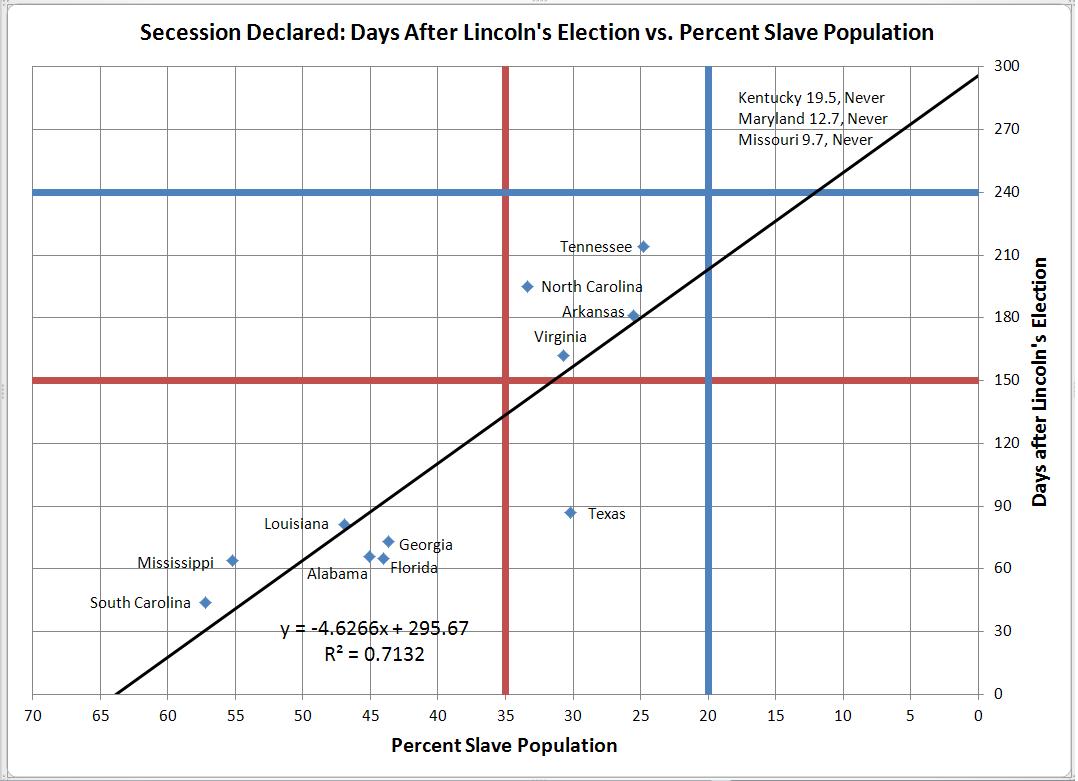
And again, the South didn’t have a monopoly on racism. It was a profound element in the North as well. But, as Hale accurately points out in the letter, the number of blacks in the North was negligible. In the Deep South, it was nearly half. And the correlation between numbers of slaves and rate of secession is stunning. This graph by Michael Rogers, which  you can find posted at Kevin Levin’s Civil War Memorycompiles data from the census of 1860:

secessiondeclared

The Deep South (except for Texas—I’m not sure what their deal was), with percentages of blacks in each state over 40%, left fairly quickly. The Upper South waited until shots were fired, but left as well. The Upper South states fall into a range of around 24% to 34%. And the Border states, with percentages in the teens, never left at all.

It is overstating the case to say that racism—the fear of blacks—was what caused the Civil War. But as I wrote in a previous post, it is clear that it was extremely important. Southerners could live cheek-by-jowl with blacks if they had near total control over them; but they would not allow themselves to be “degraded” by living among blacks as equals.

And so, I hope George ponders this. I hope he will see that the three addresses we’ve looked at here are a tiny fraction of the number such addresses from these commissioners, and every one of them makes this same argument. I hope he recognizes that this sort of evidence is incontrovertible: this is the reason for secession right from the mouths of the participants themselves. I’d like to think that it could even cause him to change his mind about the cause of the war, and so give up the alternate, fictional version offered by neo-Confederates. We will see.

Posted in Civil War, Neo-Confederates, Secession, Slavery | Tagged , , , , , , , , , , , , | 65 Comments

Slavery and Secession: The Daily Show’s Take

Because I am buried in Midterm essays–yet again–in my Summer online courses, I don’t have time to make a proper entry. But since the topic has come up in the comments, I figured this is an excellent time to show a nice video on the relationship between slavery and secession. This was what Larry Wilmore and Jon Stewart of The Daily Show came up with back in 2010 during the sesquicentennial of South Carolina’s secession. Enjoy!

The South’s Secession Commemoration

Posted in Uncategorized | Tagged , | 262 Comments

“We Must Disenthrall Ourselves”

“We Must Disenthrall Ourselves”

In an interview promoting the Steven Spielberg film Lincoln, Daniel Day Lewis discussed how he read Lincoln’s speeches as a way to prepare his epic performance. In particular, Day Lewis told the interviewer, he was surprised to find that Lincoln used the word “disenthralled.” “I’d never seen that word before and I’m always looking for a context ever since where I can use that word, I love it so much….The richest source, which creates a very broad, illuminated avenue towards an understanding of Lincoln and his life is through his own words and his own language.”

And, come to think of it, I’ve never heard the word, either—not in any presidential address, nor any form of writing, nor even in actual speech. I can never remember hearing another human use the word. Lincoln’s message to Congress in December, 1862, is the only time I can think of ever hearing disenthrall:

The dogmas of the quiet past, are inadequate to the stormy present. The occasion is piled high with difficulty, and we must rise with the occasion. As our case is new, so we must think anew, and act anew. We must disenthrall ourselves, and then we shall save our country.

The context, of course, is the eve of the final Emancipation Proclamation. At midnight on January 1863, the Civil War was going to take a drastic new course. Slaves held in rebel-controlled territory would be considered free; all they had to do was get to the Union armies. And these former slaves would be encouraged to join those armies and then smite the men who had held them in bondage. Lincoln had come to realize, sometime in the late spring of 1862, that the war could not be won without striking at the institution that ultimately caused destruction of the Union. And so, as a war measure, Lincoln changed the terms of the war from one of restoring the Union alone to one of liberation.

Pretty dramatic stuff.

Of course, the word enthrall is not mysterious at all, really. It’s right there in Webster’s Dictionary. My mom used to use it fairly frequently. She always used it as a synonym for “fascinated” or “enchanted” or “infatuated.” to the point of being in someone else’s power. She used it for people who she was in awe of, usually actors and the like: “I’m just enthralled with him!” Often, a young man might become “enthralled” with a young woman—and, in this context, behave foolishly. The definition the word has always had for me was some kind of mystic hold on a person. But that is just one of the two definitions in Webster’s.

The other definition for enthrall in Webster’s is “to enslave.” I had never had an opportunity to hear enthrall in this context until I read The Lord of the Rings as a 14-year-old. More than once, Tolkien says the Dark Lord held so-and-so “in thrall.” He was usually speaking of some weak-minded tribe of men, easily swayed by the allure of evil power. And so while I never explicitly heard it as a meaning for enslaved, I certainly absorbed the gist—which is, really, the way we all learn new words. But even so, as I think back on it, I’ve never heard another human add the prefix and utter the word “disenthrall”—except for Day Lewis in that interview, and Lincoln, and anyone reading his words.

Eric Foner has remarked that the Emancipation Proclamation emancipated not just the slaves, but Lincoln himself. It marked a profound change in his thinking, and enabled him to cast off the long-championed, beguiling chimera of colonization—freeing blacks, but then encouraging them to relocate outside the United States. Whatever happened after January 1, 1863, the United States was going to fight a war for the liberation of 4 million Americans. How would the nation regard these new freedmen—180,000 of whom picked up a rifle, put on a blue coat, and spilled their blood for their country? What sort of rights would they be accorded? It was these questions many mainstream Republicans fretted over on the eve of emancipation.

And this shift in the war toward liberty and equality—this was not originally what Lincoln had wanted; from the beginning he had been trying to keep the war from becoming “a remorseless revolutionary struggle,” as he had put it exactly one year earlier in the State of the Union in 1861. But a brutal, bloody year had gone by, and now Lincoln was saying that revolution was here–that, in his mind, the inexorable logic of the war pointed toward freedom.

One of the many ironies of the Civil War is that Lincoln, one of the greatest and most articulate proponents of Jefferson’s idea that all men are created equal, resisted that principle until pursuing it was the only way to win the war. This is not a criticism; on the contrary, this is Lincoln both following through on his commitment to the Constitution, and recognizing the atmosphere of public opinion. He had stated again and again that slavery was protected in the Constitution; and he had also stated that whatever his notions on black equality, as a politician he was required to bow to public opinion, a position he clearly laid out in 1858 in the Lincoln-Douglas debates:

What next? Free them [blacks], and make them politically and socially our equals? My own feelings will not admit of this; and if mine would, we well know that those of the great mass of white people will not. Whether this feeling accords with justice and sound judgment, is not the sole question, if, indeed, it is any part of it. A universal feeling, whether well or ill-founded, cannot be safely disregarded. [My emphasis.]

That was in peacetime. In wartime, Lincoln understood that the life of the nation depended on striking at slavery, and even then only if he could frame it as a legitimate war measure. And by the middle of 1862, it most certainly was. His job, then, was to coax along his countrymen, and get them to understand that their “universal feeling” was outdated, was no longer relevant, and must be discarded. And Lincoln, as usual, found precisely the right word, the right phrase, to communicate with his people:

We must disenthrall ourselves, and then we shall save our country.

In that state of the Union message, Lincoln was expressing to Americans they must rid themselves of this infatuation—a morbid fascination, to our way of thinking—with the unknown status of millions of newly emancipated blacks. The logic of the Union was gesturing more and more emphatically toward liberty and equality, for all. In short, it was time for white Americans to get over themselves so they could win this war for Union, democracy, and liberty. The details Americans could figure out later.

Posted in Civil War, Lincoln's Words, Slavery | Tagged , , , , | 15 Comments

Yes, Slavery Did Cause the Civil War, Part 4

Slavery and Society

The Confederate states seceded, then, because they suspected Lincoln and the North would, sooner or later, abolish slavery. They clearly dreaded the end of slavery. I trust the previous posts have shown this, but there’s one last issue. Why did Southerners fear the end of slavery so much?

This is a complex issue, but it is ultimately based on the fact that the South was a slave society. One can attempt to separate out other issues—economics, increasing hostility toward the North, a growing sense of nationalism—but in the end, all of these issues inexorably point back to slavery.

Scholars differentiate between slave societies and societies that have slaves. The difference lies in the completeness with which slavery affects every aspect of a society. It is a bit difficult to convey to the modern reader the totality of slavery in the South. Historian Peter Kolchin writes:

Slavery affected the whole South, not just the slaves.…Because the antebellum South was a slave society, not merely a society in which some people were slaves, few areas of life there escaped the touch of the peculiar institution….Slavery undergirded the Southern economy, Southern politics, and, increasingly, Southern literary expression. Slavery also buttressed the religious orthodoxy that set the South apart from the North, undermined the growth of a variety of reform movements, and helped shape virtually every facet of social relations, from the law and schooling to the position of women. By the eve of the Civil War, slavery virtually defined the South to both Southerners and Northerners; to be “anti-Southern” in the political lexicon of the era meant to be anti-slavery, to be “pro-Southern” meant to be pro-slavery. Few in either North or South doubted that the South’s way of life was a reflection of that section’s slave-labor system. When the challenge to that system appeared too great, Southern political leaders demonstrated the extent to which they identified slavery as central to their world by taking their states out of the Union and into war.

Was slavery so crucial to the economy of the South that economic concerns alone could have provoked secession? Perhaps. The profitability of slavery, once questioned by scholars, is now beyond question: slaves represented more capital investment than all other capital investments combined. Add up all the money invested in factories, banks, and railroads; the money sunk into slaves eclipses all. Eric Foner has recently pointed out [1:40] that American slavery—at nearly 4,000,000 slaves worth $3.5 billion (which works out to something like $75 billion in today’s money)—was the largest, wealthiest slave society in the history of the world. The staple crops these slaves produced (mostly cotton in the Deep South, but sugar as well) represented a vast source of wealth to the entire country—not just in exported staples, and raw cotton shipped to Northern factories, but in the slaves themselves. Slaves were bought, sold, brokered, insured, loaned out, and used as collateral in loans. (This massive source of capital and wealth shows that the modern Libertarian argument that slavery was dying out is pure fantasy.) So it’s not surprising that slaveholders should have objected to any notion that slavery was wrong in any way—either economically backwards, destructive of republican liberty, or morally reprehensible. It’s conceivable that for economic reasons alone, slaveholders would have violently resisted abolition. They might have considered secession for purely economic reasons, as Federalists in New England did with the Hartford Convention during the War of 1812.

One of the characteristics of the 1840s and 1850s is the increasing hostility between the sections. Southerners more and more began to feel that Northerners—especially abolitionists—insulted Southern honor. Words like “insolent” turn up again and again in the historical record. As New Englanders and other “insolent Yankees” increased their criticism of slavery, so Southerners increasingly felt their “way of life” was under attack, and they mobilized to defend themselves. It was John C. Calhoun who developed the most sophisticated arguments for the South. Using the “offense is the best defense” model, he defended slavery by attacking the “way of life” of Northerners, accusing them of being hypocrites. Plantation owners took care of their laborers from cradle to grave, Calhoun argued; Yankee factory owners forced their workers to fend for themselves, to become in effect “wage slaves.”

This increased hostility was fed significantly by the increasing dependence of Southern cotton producers on Northern financiers. In order to turn their staples into greater and greater profits, plantation owners had to rely more and more on outside expertise. But the more Southerners grew in outward prosperity, the more debt they seemed to be in; and most of this debt was owed to New York bankers and the like. Nobody loves their creditor. To carry on the lavish lifestyles to which the Southern gentry were accustomed meant leveraging more and more cotton and more and more slaves. Alan Taylor, in his excellent book The Internal Enemy: Slavery and War in Virginia, 1772-1832, demonstrates that one of chief reasons for not freeing slaves was simply that slave-owners were in too much debt to manumit slaves, even if they wanted to.

But these reasons for wishing to protect slavery—the great wealth it generated,  the anger at Northerners for disparaging them, the nationalism this anger engendered—which all hinge in one way or another on economics, don’t explain certain characteristics of the ante-bellum period, the Civil War, and Reconstruction (and beyond). What compounded matters, what made slavery indispensable to Southerners above and beyond its value as part of an economic system for controlling labor, is that American slavery was as much a tool to control blacks as it was to control labor—a slave society that ensured white supremacy. It’s my contention that these two impulses—the potential for great profitability and the legal subjugation of blacks—ranked as equally important to Southerners. This fraternization of the two became what they referred to as their “way of life”, and explains how Southern polemicists could make such crazy (to us) arguments urging secession; explains why Confederates fought so hard for so long, into 1865 when the war was clearly just a matter of time, drawing out the great pain and destruction and death, fighting far beyond what was reasonable; and explains why white Southerners went to such extraordinary lengths to perpetuate race control before, during, and long after Reconstruction—long after slavery had disappeared.

From the time Virginians institutionalized racism in the late 1660s and early 1700s, which degraded the humanity of free blacks as well as slaves, Southern lawmakers and slaveholders (which were much the same thing), equated blackness with inferiority and degradation. And it was this racism—this fear of “the other,” of blacks—that became the irrational underpinning of the entire society.

I’ve said before, and it deserves mentioning as often as possible, that race doesn’t exist. Science cannot determine a person’s “race” by looking at their DNA. Yet this notion continues to “inform” and influence institutions in society. (As Ta-Nahesi Coates has put it, race doesn’t exist; but racism does.) Since there is no such thing as race, any ideas based on race are, by definition, irrational.

And no idea perhaps is more irrational than American race-based slavery. The irony of a republic based on the principle of human liberty incorporating slavery into its organic law, overlapping with institutionalized racism, creates such an irrational foundation that we should not be surprised at all that it took a devastating war to end slavery—leaving behind the ugly stepbrother of racism.

It is important to emphasize here that in no way were Southerners alone in this racism. Racism was part and parcel of Northern politics in the nineteenth century. Politicians like Henry Clay and Abraham Lincoln, to name just two out of the majority of Northern statesmen, pushed the idea of colonization (the idea of sending free blacks out of the country, “colonizing” them in Latin America or Africa) until the end of 1862. But because numbers of blacks in the North were a fraction of what they were in the South, that racism—that irrational fear—tended to be far less vast and virulent.

Thomas Jefferson famously said, more than once, that adopting slavery was foolish, like taking “a wolf by the ears.” It was a dumb thing to do, but once done, you couldn’t let go. Well, why not? Why couldn’t white Americans accept that they had made a mistake, that slavery was wrong and free their slaves? And while it is true that some couldn’t free their slaves because of their huge debts, the real answer comes back that they couldn’t envision themselves living in a multi-racial society. The fear of free blacks living among them in large numbers was simply unthinkable. Free blacks were considered more dangerous to whites than slaves—a bizarre (irrational) notion, since free blacks had no particular need to attack whites, but enslaved blacks did. Indeed, the presence of free blacks vexed the slave society of the South.

Since almost the beginning, slave-masters had constructed a fantastical logic that bound them tighter and tighter to slavery. In The Internal Enemy, Alan Taylor shows how slavery made the Tidewater region of the Chesapeake Bay exceptionally vulnerable to British attack in the War of 1812. Virginians’ fear of all blacks, and their inability to trust free blacks—seen as bad examples to slaves who would covet freedom—meant that they were paralyzed, even as a truly dangerous, truly existent enemy in the form of the Royal Navy prowled the Tidewater shores. Virginians preferred that their militia was constantly needed at home to protect against an intangible slave revolt rather than fight the very tangible British.

And the British took advantage of this by encouraging slaves to flee their plantations in the night and board British ships, thus becoming free. The British even turned a number of these freedmen into the “Colonial Marines”: armed, uniformed, military units, terrifying the Virginia planter elite.

Events like the Haitian Revolution, the aborted slave revolt of Denmark Vesey in South Carolina, and the devastating rebellion of Nat Turner in 1831 appeared to justify Southern fears of slave revolts and free blacks. However, the simple fact that these events are so few in number—only two above occurred in the United States—confirm for us that Southerners allowed slavery to create for themselves an atmosphere of terror. Jefferson’s “fire bell in the night” quote regarding the Missouri Compromise is almost never given in its full context. In a given locale, the fire bell was rung to call volunteer firemen out to fight fire. But it was also used to call out militia in the case of slave insurrection. Thus, the “knell of the Union,” Jefferson’s chief metaphor for his fear that the Union might be destroyed by the issue of slavery, was the fear of slave insurrection.

If we then consider the irrationality caused by race-based slavery, the subsequent events beginning with the Mexican War leading to secession should not really surprise us. At every step, the Southern states behaved in an increasingly irrational fashion. (I’m going to set aside the truly insane attempts by Southern filibusteros to force Latin American countries into a “slave empire” from this narrative. We have plenty to work with without them.) Fearing the bounding of slavery by free states—and thereby putting slavery on the road to extinction—Southern aristocrats attempted to secede. Faced with Lincoln’s inflexibility on the dissolubility of the Union, and convinced that remaining was a direct threat to slavery, Southerners chose war against “the colossus of the North”–a war, of course, that ironically destroyed slavery. Confronted by defeat on all fronts in the winter of 1864 and 1865, the Confederacy continued to fight, continued to see its young men killed, continued to use propaganda to encourage its citizens that victory was at hand against the Yankee invader, refused to see reality as it existed. And after the war, ex-Confederates refused to accept black equality in any form. They passed the “Black Codes” to prevent that equality; they used murder and terror to prevent that equality; they delayed their own readmission to the Union rather than submit to “negro rule.” And after the ultimate failure of Reconstruction, the systematic attempt to humiliate and control blacks through Jim Crow. And why did they do this?

Because they did not like black people.

This hypothesis of irrationality/racism helps, I think, to explain why Southerners behaved as if they were insane.

This “irrational fear/racism” idea accounts for more than just Southern secession in 1860. In his excellent long essay “Losing the War,” writer Lee Sandlin argues that the irrational cultural ideologies of Imperial Japan and Nazi Germany—ideologies based on the racial superiority of each—compelled those nations to continue fighting the Second World War far beyond what was rational. If the war had just been about territory or economics, the Axis Powers would have sued for peace long before 1945. But they did not, because both were subsumed by their own cultural superiority, and felt that defeat meant the total annihilation of that culture: for Japan, that meant the Emperor, bushido, and the myth of Amaterasu; for the Nazis, it meant the Thousand Year Reich, the volk, and the Aryan myth. Both exhorted their people to fight to the very death; that death was preferable to cultural extinction. Sandlin argues that this recalcitrance, dragging the war on beyond any reasonable hope for victory, was one of the reasons it was an easy choice for the United States to drop the atomic bombs on Japan.

So it was with the Confederacy. The war was effectively over by fall of 1864, with the fall of Atlanta and Lincoln’s election. Any reasonable people or nation would have—should have—sued for peace. But not Jefferson Davis; not the Confederacy.

(Note: I know this portion of the essay threatens to invoke “Godwin’s Law.” It is not my intent to compare Southerners to Nazis, far from it. My purpose is merely to compare the irrational nature of the cultures to which each clung beyond reason.)

Their behavior shows what can only be considered irrational fury. From seceding because they disliked an election result, to fighting the war long past what can be considered reasonable, to their treatment of freedmen during Reconstruction—all of this behavior suggests deep irrational fear.

And so this, ultimately, is why slavery caused the American Civil War. The racism we live with today is not the residue of slavery; it is slavery’s brother.

Posted in Civil War, Secession, Slavery | Tagged , , , , , | 153 Comments

The Real Lost Cause

Because I’m up to my eyeballs grading midterms, I haven’t had a chance to finish my series on slavery as the cause of the Civil War. So, to entertain readers in the meantime, here’s a video of a talk by historian Gary Gallagher.

One of the things that is difficult for us to comprehend today is the idea that most Americans 150 years ago considered the Union sacred—sacred enough to die for. Lincoln was not the only Northerner who realized that secession meant the destruction of the American government, and thereby the destruction of, as Lincoln put it, “The last best hope of mankind.” Prof. Gallagher is a pretty funny guy and does an excellent job of conveying this urgency in this lecture and entertaining at the same time.

Posted in Civil War | Tagged , , , , , | 2 Comments

Yes, Slavery Did Cause the Civil War, Part 3.

Slavery and Power

Article I, Section 2 of the Constitution reads:

Representatives and direct Taxes shall be apportioned among the several States which may be included within this Union, according to their respective Numbers, which shall be determined by adding to the whole Number of free Persons, including those bound to Service for a Term of Years, and excluding Indians not taxed, three fifths of all other Persons. [My emphasis]

The notorious “three-fifths” clause was one of the crucial compromises of the Constitutional Convention. It meant that when counting people to see how many members each state would get in the House of Representatives, slaves would be counted as three fifths of a person. In other words, a state would be entitled to one member of the House for every 30,000 whites or 50,000 slaves. A common misconception of this is that Southerners hated blacks so much they “only counted slaves as 3/5s of a person.” But this misses the salient point, since it was Southerners who wanted to count each slave as a full person—but only for the purposes of representation. Northerners, on the other hand, didn’t want to count slaves at all. Northerners felt that counting property was silly. One doesn’t count livestock, for example, when deciding representation; why would one count slaves? And so, the compromise. But while it was necessary to get the Southern states to join the new Union, this three-fifths compromise had profound effects on the American political system, especially the shape and composition of the federal government. It led to what Northerners came to call the “Slavocracy,” or sometimes the “slave-power conspiracy.”

To begin with, slave states had a substantially greater number of members of the House of Representatives than they would have without counting slaves. For example, the states that joined the Confederacy had by 1860 just 19% of the free population of the country, yet they had almost 28% of the seats in the House. And so the three-fifths clause expanded the power of slave states in Congress.

But the effect of this moved beyond giving slave states disproportional numbers in Congress—the three-fifths clause reached into all three branches of government. The executive branch, for example: the electoral college selects the president, and states’ votes in the EC are determined by adding together the number of House seats and Senate seats a state has. Because the Southern states had an artificially inflated number of house seats, they likewise had a disproportionate number of votes to select the president. It’s no coincidence that 12 of the first 15 presidents either owned slaves or supported slavery. And because the president selects members of the Supreme Court, the three-fifths clause ensured that most nominees would likewise be supporters of slavery. Decisions like Dred Scott v. Sanford graphically demonstrate this.

Who cares? This is important because it shows that although Southerners were a minority population, they had a substantive hold on the federal government. But the rise of the Republican Party in the 1850s, and Lincoln’s election in 1860 threatened the crazy math of the three-fifths clause. The Republican platform explicitly pronounced a determination that slavery be restricted from all territories, which would mean that, if it were up to the new president, no new territories would have slaves; which meant no new slave states would enter the Union; which meant the fragile hold the “slave power” had over the federal government was destined to evaporate. Slavery had to expand or it would die—that was the conventional wisdom. But whether that was true or not, it was a fact that not expanding slavery meant slavery would die out over time. Lincoln figured 75 or so years. But Southerners were not going to wait to find out. A growing majority of free states might not wait for slavery’s evolutionary end; this growing majority might introduce a Constitutional amendment outlawing slavery altogether, with or without compensation for slave owners.

This was the threat Southern slave-owners perceived in 1860 with Lincoln’s election: the destruction of slavery. It didn’t matter what Lincoln’s timetable was; Southerners were committed to the institution. And the reason for this is far beyond economics. They were committed to slavery because of its aspect of social control.

Posted in Civil War, Secession, Slavery, Uncategorized | Tagged , , , , | 1 Comment

Yes, Slavery Did Cause the Civil War, Part 2

The Ultimate Basis of Slavery

But to begin at the very beginning, it is important to remember something I always tell my students: first and foremost, above and beyond all other considerations, slavery is based on violence. It is impossible to compel a person to labor against their will for another without the threat of violence. There are several ways to express this, but Ta-Nehisi Coates of The Atlantic has put it most bluntly: “Slavery is torture as a system of governance, corporal destruction taken as the mere cost of doing business.” This may seem obvious, but it is easy to overlook or set aside. And I believe it will help explain why modern race relations remain charged with the fear of violence.

Slavery and Institutionalized Racism

Slavery, of course, wasn’t the first choice of a labor system by early colonists. Indentured servants, mostly from England, supplied the bulk of Virginia’s workers for the colony’s first 30-odd years. But the grim environmental conditions of the Tidewater ensured that four out of every five (!) immigrants died. By the 1640s, conditions improved as the colonists began to spread their settlements out. Indentured servants began to survive their seven-year terms of service and become freemen. These freemen struggled to find good farmland, and moved into the Piedmont. This increase in the numbers of poor, resentful, armed farmers tended to unnerve the Tidewater elite—and indeed, in 1676, these farmers (both white and black, free and slave and indentured) rampaged across the Tidewater, burning plantations as they went, in Bacon’s Rebellion. This convinced plantation owners to accelerate the purchase of slaves.

This was essential. Bacon’s Rebellion showed the planter elite they couldn’t control the poor-but-free men of the Piedmont, but they could and did control slaves. In order to make common cause with the small farmers, the elite began to codify slavery. But they didn’t only codify slavery; they began to codify race. Law after law was passed in order to separate whites and blacks, until by 1702, interracial marriage was forbidden. This institutionalized racism in an effort to make common cause with poor whites became a divide-and-conquer strategy to avoid the kind of class conflict that would eventually affect the North in the nineteenth century. In addition, by combining a totally controlled labor supply with political liberalizations for the Piedmont farmers, the planters ensured the ironic result of slavery ensuring freedom.

And this is really the main point: slavery evolved to be an integral part of an economic system, a significant part of the political system, and—perhaps most important—a system of social control to ensure white supremacy. It is this last point that has guaranteed our hideous legacy of racism.

Slavery Spreads

Slavery probably doomed the United States to civil war when Constitution was drafted in Philadelphia with slavery a part of it. In order to ensure the participation of slave states, the convention embedded slavery in the organic law of the United States in three places: Article I, Section 2 (the infamous three-fifths clause); Article I, Section 9 (preventing Congress from restricting the interstate slave trade until 1808); and Article IV, Section 2, (the fugitive slave clause). These unfortunate clauses were the price of getting slave-holding states to agree to a continental Union in 1787. While apparently embarrassed by ordaining slavery in a document dedicated to ensuring republican liberty (none of the three clauses mentions “slavery” by name), it seems clear that the Founders agreed to this because they felt slavery was doomed, that it was not profitable enough to keep, that it would die a natural death. Certainly Virginia slaveholders had complained before the Revolution that they had too many slaves.

Every school kid knows what happened next: that Eli Whitney radically changed the calculus of slavery’s demise with the invention of the cotton gin. Suddenly, slavery was incredibly profitable, especially in the newly-opened Deep South, where short-staple cotton could get the 200 frostless days of growing season it required. As the 1800s matured, cotton became king.

But the wisdom of continuing to hold slaves was still an actual question Southerners (and Northerners) discussed openly. The general feeling was that slavery, though profitable, was a necessary evil. It was lamentable, a regrettable institution to establish, but what could one do? As Jefferson famously remarked of slavery during the Missouri crisis of 1820, “But, as it is, we have the wolf by the ear, and we can neither hold him, nor safely let him go. Justice is in one scale, and self-preservation in the other.” This notion of “self-preservation” is interesting, since it begins to get to the heart of what Southerners saw in slavery: that it was a way to control blacks who would certainly murder them in their beds if given a chance. But still, many Southerners in the 1820s were having an actual conversation on the morality of keeping slaves. In 1830, Virginia even had a constitutional convention debating whether or not to abolish slavery.

That all changed in 1831 with Nat Turner’s Rebellion, and Virginia decided it would not abolish slavery. The death of 63 whites (I have seen at least five different numbers here, but none less than 55), mostly women and children, shocked the country, and dramatically changed the terms of the debate. No more would Southerners allow talk of freeing slaves. That was akin to encouraging insurrection. No, those who wanted free speech in order to discuss this issue were compelled to leave the South or suffer beatings, jailing, tar-and-featherings, or death.

It is no coincidence that the Nullification Crisis in South Carolina happened the next year. South Carolina tried to “nullify”, or declare unconstitutional and void within the state, the Tariff of 1828. But the issue at stake wasn’t the tariff; it was the power of the federal government, which, if it could be used to push for a protective tariff, might be used by Northerners to abolish slavery. But South Carolina stood alone in 1832—no other slave state came to her aid and joined her protest against federal power. Why not? Why was no other southern state willing to risk the wrath of Andrew Jackson on the principal of federal power?

Because, among slave-holding states, only South Carolina had a black majority. No other Southern state had more blacks than whites.

Simply put, the implication here is that the more blacks, the more fear. The more slaves in a state, the more likely that state to resist any and all manner of anti-slavery sentiment. The fear that abolition would free slaves; the fear that freedmen in a multiracial society would murder whites in their beds; simple, irrational, racism.

And the subsequent years support this idea. As the 1830s became the 1840s, slavery grew substantially in the Deep South. Throughout the 1850s, cotton became more profitable than ever, and plantation owners sunk every spare dollar into more land and more slaves. By 1860, five states—South Carolina, Mississippi, Georgia, Alabama, and Louisiana—either had black majorities or were very close. It is no coincidence that these five states were among the first to secede.

But this still doesn’t fully explain why the Deep South seceded at all. To fully understand that, we need to understand how slavery affected the American political system.

Posted in Civil War, Neo-Confederates, Secession, Slavery | Tagged , , | Leave a comment

Yes, Slavery Did Cause the American Civil War

Slavery as the cause of war

The central pillar of the Lost Cause Myth is the notion that somehow slavery was not the ultimate cause of the Civil War. While this seems laughable on its face, the fact remains that almost every day I encounter some perfectly intelligent, reasonably well-educated person who still says, at the very least, “But there was other stuff too, right? Tariffs and stuff?” So clearly, our “Civil War memory” (which, by the way, is an excellent blog) is not as good as we could hope, and we have some work to do. But once we demolish this pillar of the neo-Confederate argument, the whole ridiculous edifice collapses.

Before we do this, let’s get this one thing absolutely clear:

Slavery was the ultimate cause of the American Civil War.

Anyone who asserts anything else is either grossly uninformed or willfully misrepresenting the facts. Plainly stated, if slavery didn’t exist, there would have been no Civil War. This is simply incontrovertible. And so the question before us is, how did slavery cause the war?This is a fine question, and one worth answering at length. But, for those of you interested, here is the short answer:

The Southern slaveholding states felt that Lincoln’s election in 1860 was a direct threat to slavery, in spite of the fact that Lincoln never claimed to have any power or jurisdiction over slavery where it existed. Because of this perceived threat, seven states of the Deep South seceded from the Union. After this new “Confederates States of America” fired on Ft. Sumter, Lincoln called for volunteers to put down the insurrection. This provoked four more states to join the new Confederacy.

These Southern slaveholding states asserted an alleged right to peacefully secede from the United States, while Lincoln maintained that the Union was perpetual and no state could unilaterally secede. Thus, both sides could technically claim that the war was not over slavery.

That’s the short version. Some may quibble, but these are the salient points. However, the short version doesn’t explain why slavery was so central to the dispute. My purpose, then, will to use subsequent blog posts to discuss “the long version” of why slavery caused the Civil War.

Posted in Uncategorized | Tagged , , , | 1 Comment

Confederate Invincibility and the Campaigns of 1864

Al Mackey over at “Student of the American Civil War” has posted this excellent lecture by Jason Phillips, Eberly Professor of Civil War at West Virginia University Studies. It shows that the Lost Cause was already establishing itself as an ideology long before the war was over.

Al Mackey's avatarStudent of the American Civil War

0329041101

This was Jason Phillips’ presentation at the Bridgewater College Civil War Institute symposium on the 1864 Valley Campaign, held March 29, 2014 at Bridgewater College in Bridgewater, Virginia.  Jason is the Eberly Professor of Civil War at West Virginia University Studies.

Jason told us that confederate soldiers in 1864 expected to win the war.  150 years ago, Sgt. Reuben Pierson wrote that the health and morale of the Army of Northern Virginia were “unsurpassed by any band of soldiers that history either modern or ancient give an account of.”  He told his sister the veterans were “eager for the opening of the spring campaign in the full belief that we will be blessed with some grand and glorious victories.”  Thousands of confederate soldiers like Reuben Pierson fought to the bitter end.  These die-hard rebels were not insane.  They were not delusional.  They were not bombastic.  They were rational people who happened…

View original post 2,713 more words

Posted in Uncategorized | Leave a comment